
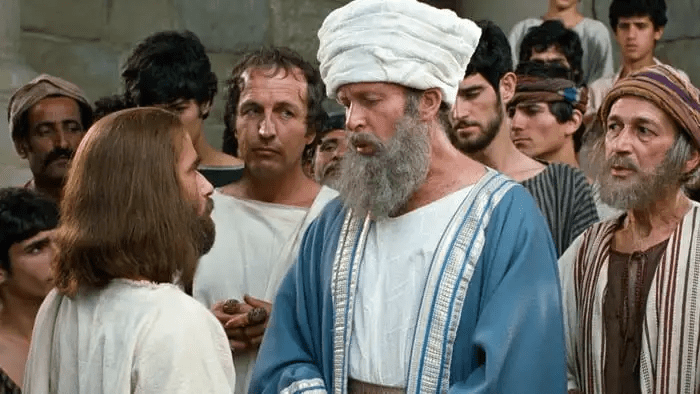
23 And when he entered the temple, the chief priests and the elders of the people came up to him as he was teaching, and said, “By what authority are you doing these things, and who gave you this authority?” 24 Jesus answered them, “I also will ask you one question, and if you tell me the answer, then I also will tell you by what authority I do these things. 25 The baptism of John, from where did it come? From heaven or from man?” And they discussed it among themselves, saying, “If we say, ‘From heaven,’ he will say to us, ‘Why then did you not believe him?’ 26 But if we say, ‘From man,’ we are afraid of the crowd, for they all hold that John was a prophet.” 27 So they answered Jesus, “We do not know.” And he said to them, “Neither will I tell you by what authority I do these things.” (Matthew 21:23–27 (ESV)
Following Jesus’ cursing of the fruitless fig tree, and His subsequent explanation this represented His judgment upon the fruitless Jewish religious leaders, these same fruitless religious leaders engaged in an acrimonious discussion with the Lord.
Jesus entered the temple and began teaching. Luke recorded Jesus was proclaiming the Gospel (Luke 20:1). The chief priests, the elders and the scribes (Mark 11:27; Luke 20:1) of the Jews approached Jesus and accusingly said, “By what authority are you doing these things, and who gave you this authority?” The religious leaders were not only referring to Jesus teaching, but also His cleansing of the temple (Matt. 21:12-13) and perhaps His triumphant entry into Jerusalem (21:1-11). They did not approve of Jesus doing “these things” and demanded the Lord justify His actions and show His credentials. In their minds, He was guilty of blasphemous sin.
The religious leader’s opposition to the Gospel was conspicuous. Instead of being God’s heralds, and spiritual shepherds of the Lord’s flock, they were His enemies. They followed in the footsteps of their ancestors (Ezekiel 34). They opposed Jesus, but could not deny His miraculous work and authoritative teaching.
In responding to the religious leaders, Jesus asked them a question. He said “I also will ask you one question, and if you tell me the answer, then I also will tell you by what authority I do these things. 25 The baptism of John, from where did it come? From heaven or from man?”
Matthew recorded the religious leaders’ discussion among themselves to Jesus’ statement. “And they discussed it among themselves, saying, “If we say, ‘From heaven,’ he will say to us, ‘Why then did you not believe him?’ 26 But if we say, ‘From man,’ we are afraid of the crowd, for they all hold that John was a prophet.”
“By means of Christ’s question his enemies had been driven into a corner. Obviously they did not want to answer, “The baptism of John had a heavenly source,” for they knew very well that the reply would be, “Why, then, did you not believe him?” On the other hand, were they to come out with what was probably that which most of them believed, or at least wanted to believe, namely, that the baptism of John was from men, the general public—perhaps especially the crowds of pilgrims that had come from Galilee—would become definitely hostile toward them, and might even stone them (Luke 20:6),” states Dr. William Hendriksen.
Therefore, the Jewish leaders said, ““We do not know.” Jesus answered, ““Neither will I tell you by what authority I do these things.”
“Jesus answers with a question of His own, a common practice in rabbinic debate. Using a synecdoche, a figure of speech in which a part (in this case, baptism) is used to represent the whole (John’s ministry), Christ asks His opponents about the authority behind John the Baptist (vv. 24–25). If they call John a prophet, they condemn themselves for not heeding him or Jesus, whom John heralded. But to say John’s authority is from men is to face the crowd’s anger. These cowards do not commit themselves either way (vv. 25–27),” explains Dr. R. C. Sproul.
Dr. John MacArthur writes, “Jesus exposes their own lack of any authority to examine Him. And since they have no standing, Christ has no need to answer them (Matt. 21:27).”
“When we, like the scribes and priests in today’s passage, refuse to submit to the evidence in front of us, we are left with no right to expect further revelation of the truth. Obedience today is the prerequisite for fuller knowledge of the things of God tomorrow,” concludes Dr. Sproul.
Soli deo Gloria!
 His Word Today