
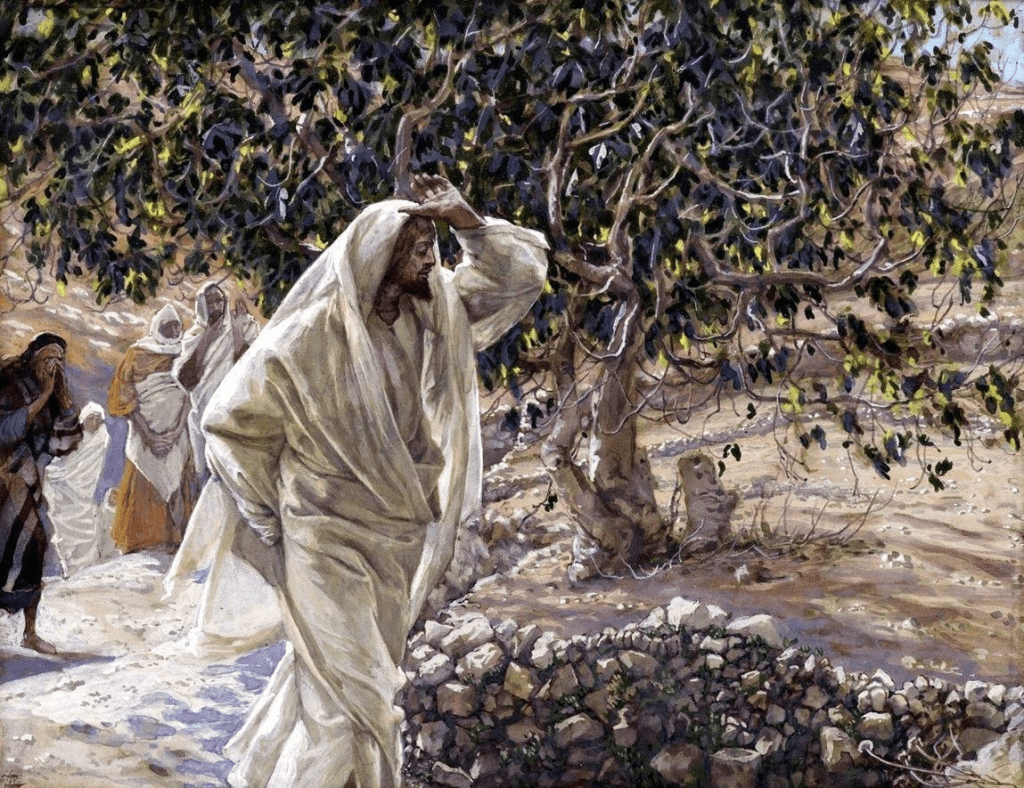
18 In the morning, as he was returning to the city, he became hungry. 19 And seeing a fig tree by the wayside, he went to it and found nothing on it but only leaves. And he said to it, “May no fruit ever come from you again!” And the fig tree withered at once. (Matthew 21:18–19 (ESV)
The Scriptures contain many object lessons of doctrinal truth. Many are direct and easy to understand. Others are more obscure. Today’s text falls into the latter category.
Following the previous day’s events, Jesus returned to Jerusalem from the village of Bethany (Matt. 21:17). Matthew records Jesus was hungry. This was an evidence of Jesus’ humanity. As a man, He needed food while on earth as we do (Luke 24:36-43; John 21:9-14).
It was at this moment the Lord saw a fig tree by the road to the capital city, He went to it, presumably to pick some figs and have something to eat. However, He found there was nothing on the tree except leaves. He then said to the tree, “May no fruit ever come from you again! And the fig tree withered at once.” This was another example of Jesus’ authority over His creation (Matt. 8:23-27).
“Jerusalem was full of visitors during Passover season. By this time of year fig trees near the Mount of Olives would have leaves, but only green fruit with an unpleasant taste appeared this early; edible figs appeared around early June. Often the green fruit would fall off, leaving only leaves,” explains commentator Craig Keener.
Was Jesus upset and angry at the fruitless tree? Was this a display of frustration by the Lord? If so, does this mean becoming frustrated is justified when things don’t happen the way we want? Does the fig tree illustrate believers in Christ? Will the Lord curse us when, or if, we become fruitless in our spiritual walk?
“It is impossible to believe that the curse which the Lord pronounced upon this tree was an act of punishing it, as if the tree as such was responsible for not bearing fruit, and as if, for this reason, Jesus was angry with it. The real explanation lies deeper. The pretentious but barren tree was a fit emblem of Israel. See Luke 13:6–9 (cf. Isa. 5),” explains Dr. William Hendriksen.
“The pretentious fig tree had its counterpart in the temple where on this very day (Monday), as has already been noted, a lively business was being transacted so that sacrifices might be made, while at the same time the priests were plotting to put to death the very One apart from whom these offerings had no meaning whatever. Plenty of leaves but no fruit. Bustling religious (?) activity, but no sincerity and truth. In cursing the fig tree and in cleansing the temple Jesus performed two symbolic and prophetic acts, with one meaning. He was predicting the downfall of unfruitful Israel. Not that he was “through with the Jews,” but that in the place of Israel an international and everlasting kingdom would be established, a nation bringing forth not just leaves but fruits, and gathered from both Jews and Gentiles.”
The doctrine of fruit bearing is a consistent theme throughout the New Testament. It is the mark of a true believer in Jesus Christ. The lack of spiritual fruit does not reveal an individual has lost their salvation in Christ. Rather, it proves they never possessed salvation.
Matthew 3:4–8 (ESV) – “Now John wore a garment of camel’s hair and a leather belt around his waist, and his food was locusts and wild honey. 5 Then Jerusalem and all Judea and all the region about the Jordan were going out to him, 6 and they were baptized by him in the river Jordan, confessing their sins. 7 But when he saw many of the Pharisees and Sadducees coming to his baptism, he said to them, “You brood of vipers! Who warned you to flee from the wrath to come? 8 Bear fruit in keeping with repentance.”
Matthew 7:15–20 (ESV) – “15 Beware of false prophets, who come to you in sheep’s clothing but inwardly are ravenous wolves. 16 You will recognize them by their fruits. Are grapes gathered from thornbushes, or figs from thistles? 17 So, every healthy tree bears good fruit, but the diseased tree bears bad fruit. 18 A healthy tree cannot bear bad fruit, nor can a diseased tree bear good fruit. 19 Every tree that does not bear good fruit is cut down and thrown into the fire. 20 Thus you will recognize them by their fruits.”
John 15:1–8 (ESV) – “I am the true vine, and my Father is the vinedresser. 2 Every branch in me that does not bear fruit he takes away, and every branch that does bear fruit he prunes, that it may bear more fruit. 3 Already you are clean because of the word that I have spoken to you. 4 Abide in me, and I in you. As the branch cannot bear fruit by itself, unless it abides in the vine, neither can you, unless you abide in me. 5 I am the vine; you are the branches. Whoever abides in me and I in him, he it is that bears much fruit, for apart from me you can do nothing. 6 If anyone does not abide in me he is thrown away like a branch and withers; and the branches are gathered, thrown into the fire, and burned. 7 If you abide in me, and my words abide in you, ask whatever you wish, and it will be done for you. 8 By this my Father is glorified, that you bear much fruit and so prove to be my disciples.”
Galatians 5:22–23 (ESV) – “22 But the fruit of the Spirit is love, joy, peace, patience, kindness, goodness, faithfulness, 23 gentleness, self-control; against such things there is no law.”
May the fruit of the Spirit within us be seen be others today. Have a blessed day in the Lord.
Soli deo Gloria!
 His Word Today