
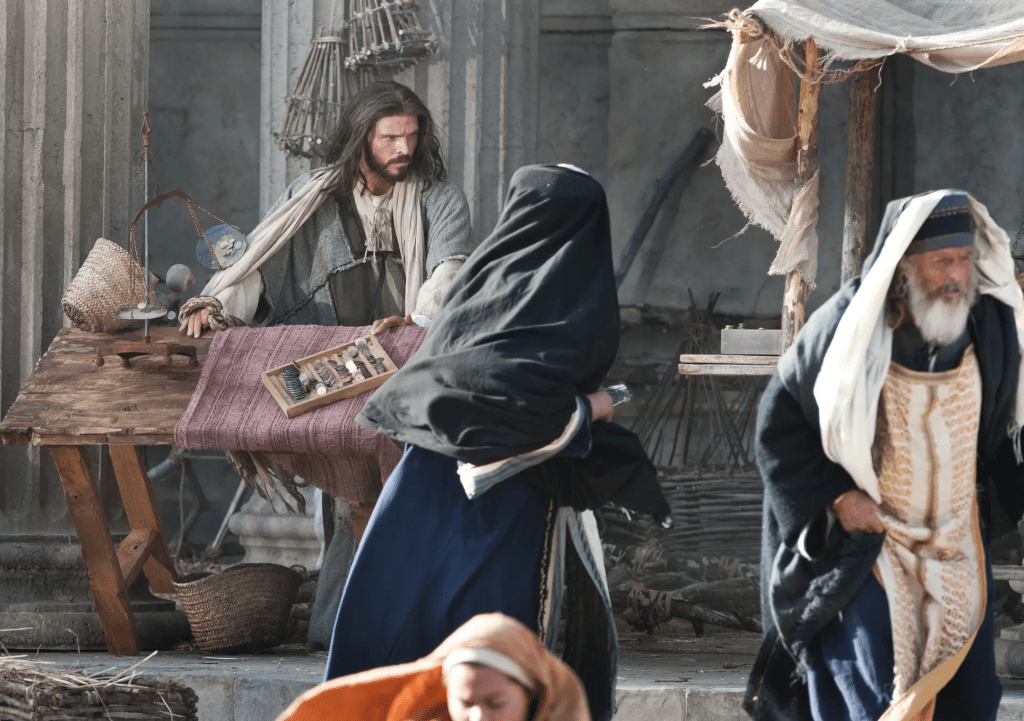
12 And Jesus entered the temple and drove out all who sold and bought in the temple, and he overturned the tables of the money-changers and the seats of those who sold pigeons. 13 He said to them, “It is written, ‘My house shall be called a house of prayer,’ but you make it a den of robbers.” (Matthew 21:12–13 ESV)
Jewish expectations of Messiah’s arrival were huge after Jesus came into Jerusalem on a donkey (Matt. 21:1–11). The people expected the Lord to begin driving out Rome from Israel. His next action contributed to this idea.
Matthew recounts Jesus cleansing the Jerusalem Temple a second time. John 2:13-22 records an earlier cleansing in the Lord’s ministry. Both incidents depict a public purging of the crass commercialism associated with the worship of God by the Jewish religious leaders.
Herod the Great (72 BC – 4 BC) administrated many building projects in Israel when he served as a vassal king for the Roman government. Of all his constructions, none were greater than the temple in Jerusalem. This was located at what is now called the Temple Mount; an area of approximately thirty-five acres.
Only the Jewish priests could enter the temple itself. It was surrounded by three courts: (1) Jewish men could enter the court closest to the temple. (2) Both Jewish men and women could occupy the next court. (3) The Court of the Gentiles, located furthest from the temple structure, was the closest any non-Jew could get to the sanctuary.
“From around the world, first-century Jews came to the temple at Passover to sacrifice to the Lord (Ex. 12:1–28; Lev. 23:4–8). It was impractical to bring sacrificial animals long distances; so, they were available in Jerusalem — for a price,” explains Dr. R. C. Sproul.
Jesus drove out those who not only sold but also bought in the temple area. He then overturned the tables of the moneychangers and those who sold pigeons. When He did so, He quoted Isaiah 56:7 and Jeremiah 7:11 in referring to what the temple should be, a house of prayer, in contrast to what it became, a den of robbers.
“He regarded both merchants and customers guilty of desecrating the temple. Items being bought and sold included “pigeons” and other animals for sacrifice (cf. John 2:14). Currency-exchange agents, present in droves, were needed because Roman coins and other forms of currency were deemed unacceptable for temple offerings. Evidently, both merchants and money-changers were charging such excessive rates that the temple marketplace took on the atmosphere of a thieves’ den (Matt. 21:13). This kind of commerce took place in the court of the Gentiles, a large area covering several acres on the temple mount,” states Dr. John MacArthur.
I wonder how this compares to the commercialization of Christianity by religious marketers? Often in the mail, I receive a magazine containing all sorts of mementoes, figurines, wall-hangings, bookmarks, t-shirts, sweatshirts, hoodies and hats advertising all manner of so-called Christian slogans. All are available for a price. It’s troubling to see the Gospel so closely associated with American capitalism.
“Our Redeemer’s cleansing of the temple at the very least illustrates how concerned He is with the purity of worship. Our corporate praise and prayer is something that is always in need of reformation, for it is easy for anti-Christian practices to slip in unnoticed. Consider the importance of pure worship from a devoted heart and make it your aim to show reverence and awe when you praise the Lord alongside His people,” concludes Dr. Sproul.
Soli deo Gloria!
 His Word Today