
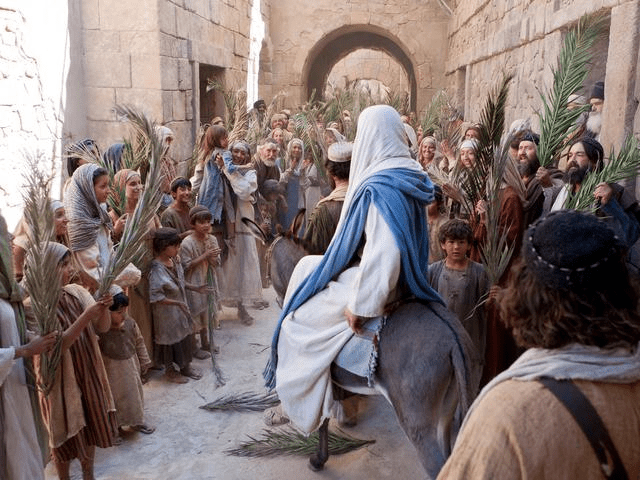
8 Most of the crowd spread their cloaks on the road, and others cut branches from the trees and spread them on the road. 9 And the crowds that went before him and that followed him were shouting, “Hosanna to the Son of David! Blessed is he who comes in the name of the Lord! Hosanna in the highest!” 10 And when he entered Jerusalem, the whole city was stirred up, saying, “Who is this?” 11 And the crowds said, “This is the prophet Jesus, from Nazareth of Galilee.” (Matthew 21:8–11 (ESV)
What was the significance of the crowds spreading their cloaks on the road when Jesus approached Jerusalem? Spreading one’s garments on the road was an ancient act of homage to a coming king and reserved solely for high royalty. The Jews were acknowledging Jesus as their coming Messiah. However, the type of king they expected and wanted as not a Savior from their sins but rather a deliverer from the Roman government.
This is the context for the continual shouting “Hosanna to the Son of David! Blessed is he who comes in the name of the Lord! Hosanna in the highest!” Hosanna (Ὡσαννὰ) literally is a cry for help or happiness. It is a cry for someone to save and rescue.
“This is an exact quotation from verse 26 of the same psalm. This, along with the messianic title “Son of David,” make it clear that the crowd was acknowledging Christ’s messianic claim (see note on Matt. 1:1). The date of this entry was Monday, 10 Nisan, A.D. 30, exactly 483 years after the decree of Artaxerxes mentioned in Dan. 9:24–26,” explains Dr. John MacArthur.
Matthew perhaps used hyperbole or exaggeration when he wrote “And when he entered Jerusalem, the whole city was stirred up.” However, since the Holy Spirit inspired Matthew (2 Tim. 3:16-17; 2 Peter 1;20-21), we can be confident of the text’s grammatical accuracy. The phrase stirred up (σείσθη; eieisethe) means to quake, sit in motion or to quake with fear. It can also mean to get excited. This latter definition fits the context.
“Just as “all Jerusalem” was “troubled” in Matthew 2:3 when the King of the Jews was born, so here the religious establishment is once again stirred up, fearing that Jesus may usurp their power,” explains one commentator.
The people of Jerusalem continually asked, “Who is this?” Many people did not know who Jesus was let alone He was the prophet who Moses spoke of in Deuteronomy 18.
“Although Moses had predicted the coming of a “prophet like me,” to whom “you shall listen” (Deut. 18:15–18; see note on John 6:14), there is no indication that the crowds here in Jerusalem recognized Jesus as that prophet,” states one Bible scholar.
The ignorance of the crowd regarding Jesus’ identity at the time of His triumphant entry into Jerusalem would be equaled by their crucifixion of Him outside of Jerusalem later the same week. The contrast is loaded with irony.
Soli deo Gloria!
 His Word Today