
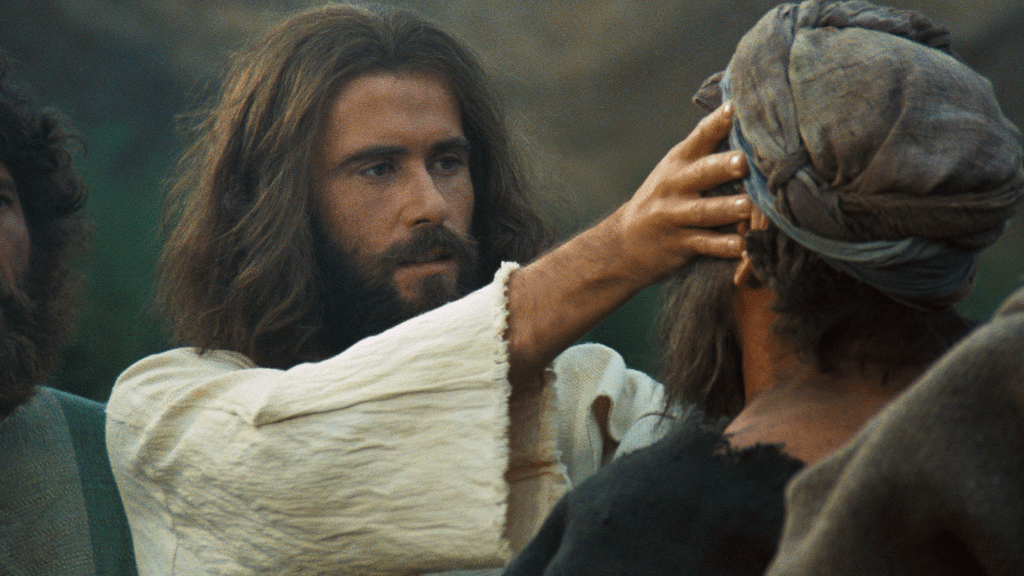
29 And as they went out of Jericho, a great crowd followed him. 30 And behold, there were two blind men sitting by the roadside, and when they heard that Jesus was passing by, they cried out, “Lord, have mercy on us, Son of David!” 31 The crowd rebuked them, telling them to be silent, but they cried out all the more, “Lord, have mercy on us, Son of David!” 32 And stopping, Jesus called them and said, “What do you want me to do for you?” 33 They said to him, “Lord, let our eyes be opened.” 34 And Jesus in pity touched their eyes, and immediately they recovered their sight and followed him.” (Matthew 20:29–34 ESV)
In the early days of Jesus’ ministry, He healed two blind men (Matt. 9:27-31). At this time, John the Baptist, while in prison, sent his disciples to inquire if Jesus was the Christ. The Lord’s response in part was the blind received their sight (11:1-5).
Once again, Matthew recorded the healing of two blind men. However, Mark and Luke indicate there was only one; Bartimaeus, the Son Timaeus (Mark 10:46-52; Luke 18:35-43). Is this a biblical contradiction? Many solutions are offered. The likely explanation is Mark and Luke refer to the more vocal and insistent of the two men Matthew mentioned.
The text indicates Jesus and His disciples left Jericho on their way to Jerusalem (Matt. 20:17-19). A great crowd followed them.
“Jesus will soon arrive in Jerusalem to complete His messianic work, for He has been in Jericho, located fifteen miles or so from the Holy City, about a day’s journey in first-century Judea. Leaving Jericho, Christ and His followers begin the ascent 3,000 feet up to Jerusalem, but they do not get very far before meeting two desperate men in need,” explains Dr. R. C. Sproul.
Two blind men sat by the roadside. Presumably this was to receive alms (money) from passersby. They heard Jesus was passing their way and began to passionately cry out, shout, and even scream “Lord, have mercy on us, Son of David!” While the crowd told them to be quiet, they cried out all the more intensely.
These blind men, one of whom is named Bartimaeus (Mark 10:46), beg Jesus to heal them, confessing Him as the “Son of David” (Matt. 20:30), a title loaded with messianic assumptions. Knowing that the Messiah is present gives them hope that He will fulfill His call to work miracles and give them sight (see Isa. 35),” states Dr. Sproul.
“Although the road from Jericho to Jerusalem was notorious for robbers, it was widely used, and larger companies (such as Jesus’) would face no threat. Jericho was one of the wealthiest cities of Judea and beggars there would not starve, but their vocation as beggars and dependents still marked them as poor and at the bottom of the socioeconomic scale—“nobodies” who were dependent on the pity of passersby. “Son of David” indicates that they acknowledge Jesus as Messiah. “Have mercy on us” could be a common cry for alms, though here they seek more,” explain commentator Craig Keener.
At that moment, Jesus stopped and asked them, “What do you want me to do for you?” They replied, “, “Lord, let our eyes be opened.” It was at that precise moment “Jesus in pity touched their eyes, and immediately they recovered their sight and followed him.”
Jesus graciously gave the two men physical sight. By following Jesus, the two men gratefully evidence spiritual sight.
Jesus was on His way to Jerusalem to accomplish the significant work God the Father had purposed for Him (John 17:1-5). However, He took the time to minister to two men who appeared to be insignificant.
“When we do the work of ministry it can be easy to get so caught up in the big plans and programs we have going that we miss the needs of certain individuals among us. As followers of Jesus, we must imitate His compassion and take the time to minister to hurting individuals even if it may sometimes get in the way of our own plans and purposes,” concludes Dr. Sproul.
What are you doing in your church to make sure people are shown compassion and are not forgotten? Have a blessed day of ministry.
Soli deo Gloria!
 His Word Today