
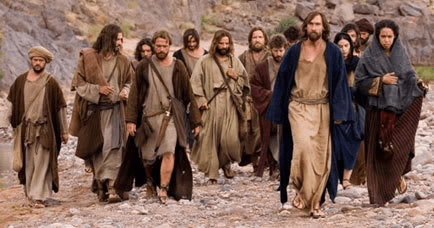
17 “And as Jesus was going up to Jerusalem, he took the twelve disciples aside, and on the way he said to them, 18 “See, we are going up to Jerusalem. And the Son of Man will be delivered over to the chief priests and scribes, and they will condemn him to death 19 and deliver him over to the Gentiles to be mocked and flogged and crucified, and he will be raised on the third day.” (Matthew 20:17–19 (ESV)
Matthew records the third time Jesus predicted His trials, condemnation, mocking, flogging, crucifixion, but also His resurrection (Matt. 16:21; 17:22-23). This third prediction reveals more about the kind of death He would die than the previous two.
21 “From that time Jesus began to show his disciples that he must go to Jerusalem and suffer many things from the elders and chief priests and scribes, and be killed, and on the third day be raised.” (Matthew 16:21 (ESV)
22 “As they were gathering in Galilee, Jesus said to them, “The Son of Man is about to be delivered into the hands of men, 23 and they will kill him, and he will be raised on the third day.” And they were greatly distressed.” (Matthew 17:22–23 (ESV)
Jesus previously said He would suffer from the Jewish elders, chief priests and scribes and be delivered into the hands of men. He also clearly stated He would be killed, but He did not mention how He would die. However, Jesus also stated that He would be raised on the third day following His death.
In today’s text, Jesus again takes the initiative and tells His disciples what He would soon be experiencing in Jerusalem. He identified Himself as the Son of Man. This is a clear reference to Daniel 7:13-14. It is a title of deity.
Jesus stated the Jewish religious leaders (chief priests and scribes) would condemn Him to death. Jesus continued by saying that Jewish leaders would then hand Him over to the Gentiles (Romans) to be mocked, flogged and crucified. Crucifixion was the Roman government’s means of public execution of condemned criminals. Jesus also said, for the third time, He would be resurrected on the third day following His death.
The events Jesus described were not circumstances beyond either His, or God the Father’s, control and preordained plan. As the Apostle Peter would later preach on the Day of Pentecost, Jesus’ death, burial and resurrection were according to the definite plan and foreknowledge of God (Acts 2:21-24).
“Following the parable of the laborers in the vineyard, Jesus’ advance toward the cross progresses in earnest. He is drawing ever closer to Jerusalem and in today’s passage explicitly predicts His death and resurrection for the third time. Jesus has succeeded where His people failed, overcoming Satan’s temptations (Matt. 4:1–11), rightly understanding and teaching God’s law (chap. 5–7), and initiating the restoration of the cosmos (9:18–26; 12:9–14; 17:14–21). He has fully qualified Himself to be the true Israel and hence, the new Adam, whose perfect obedience will justify all those in Him (Isa. 53). All that remains for Christ to accomplish salvation is to endure the punishment David’s line deserved for leading God’s people astray (2 Sam. 7:1–17) and, in so doing, endure the curse Adam’s children deserve for violating the Father’s will (Gal. 3:10–14),” Explains Dr. R. C. Sproul.
While the crucifixion would certainly be bad news, Jesus also gave the good news of His resurrection (v. 19). Jesus gave this hopeful message, Puritan Matthew Henry comments, “to encourage his disciples, and comfort them, and to direct us, under all the sufferings of this present time to look at the things that are not seen, that are eternal, which will enable us to call the present afflictions light, and but for a moment.”
Soli deo Gloria!
 His Word Today