
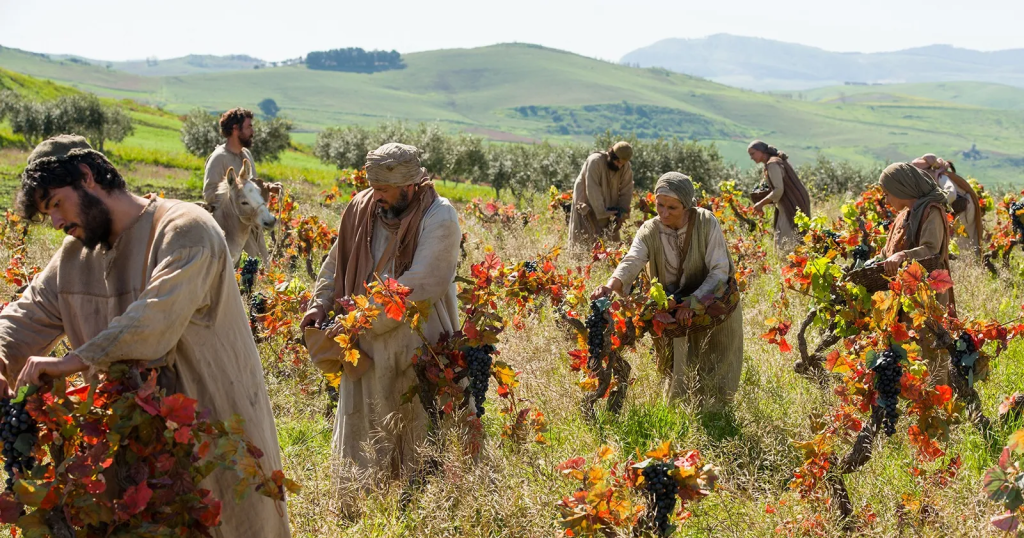
8 “And when evening came, the owner of the vineyard said to his foreman, ‘Call the laborers and pay them their wages, beginning with the last, up to the first.’ 9 And when those hired about the eleventh hour came, each of them received a denarius. 10 Now when those hired first came, they thought they would receive more, but each of them also received a denarius.” (Matthew 20:8–10 ESV)
Jesus taught this parable to His disciples (Matt.19:23-30). He compared God’s eternal rule and reign in heaven, and citizenship therein, to a master and his laborers. This master went out (ἐξέρχομαι; exerchomai) or initiated an act of hiring laborers or workers for his vineyard.
The master and the laborers agreed to a denarius a day. A denarius (δηνάριον; denarion) was a common laborer’s wage for one long day’s work (Matt. 20:2, 9; Mark 14:5; Luke 10:35; 20:24; John 6:7; Rev 6:6). Upon this mutual agreement, the master sent the laborers into his vineyard.
At the third hour of the day (9:00 am), the master went to the marketplace (agora). This was the location where the unemployed generally gathered perhaps hoping someone would hire them for the day. The master chose to do so promising to pay them what was right. The unemployed workers agreed and went to the vineyard.
The master went back to the marketplace and continued to hire more workers. He did so at the sixth hour (Noon), the ninth hour (3:00 pm), and even at the eleventh hour (5:00 pm). He sent all of them to the vineyard presumably promising to pay them what was right.
Quitting time arrives at the twelfth hour (6:00 pm). When this evening hour comes, the master instructed his foreman to call all the laborers. This was so the foreman can pay them their day’s wages. God’s Law required a prompt, daily compensation of day laborers (Lev. 19:13; Deut. 24:14-15; James 5:4).
“When evening had come!” Here the real meaning, the one main lesson, begins to come through; for this evening of the day indisputably points to the evening of the world’s and of the church’s history, the great day of the final judgment and of the manifestation of God’s kingdom in all its glory,” explains Dr. William Hendriksen.
Additionally, the master instructed his foreman to pay the laborers hired last first, and sequentially the other laborers until the laborers hired first were paid last. The foreman did as his master directed him. Each laborer received a denarius. The laborers the master initially hired at the beginning of the day mistakenly thought they would receive more. However, they also received the agreed upon denarius.
“Wages were generally paid when the working day was done (see Lev. 19:13; Deut. 24:15). What is strange, though, is that the foreman is told that when he calls the workers to pay them he must first pay those who had started to work last of all, at 5 P.M.; next, those who had begun at 3 o’clock, and so on until he finally paid those who had started first. Clearly this surprising order is in harmony with the rule laid down in verse 20:16 (cf. 19:30): the last are going to be first, and the first last. Besides, those who had come first must be given an opportunity to see what happened at the close of the day to those who had come later. Had the far more usual rule “first come first served” been applied, those first-comers would have taken their money and gone home before seeing what happened to the others,” states Dr. Hendriksen.
What was the response by the workers who labored throughout the twelve hour day and who received the same wage as those who worked less than they? We will examine Jesus’ poignant principle of His parable when next we meet. Have a blessed day in the Lord.
Soli deo Gloria!
 His Word Today