
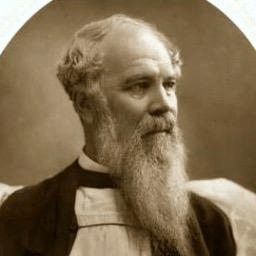
John Charles Ryle (10 May 1816 – 10 June 1900) was an English evangelical Anglican bishop. He was the first Anglican bishop of Liverpool. He was a writer, pastor and an evangelical preacher. Among his longer works are Christian Leaders of the Eighteenth Century (1869), Expository Thoughts on the Gospels (7 vols, 1856–69), and Principles for Churchmen (1884).
For the next several days, His Word Today reprints Ryle’s essay of The Rich Young Man. Be edified and enjoy.
“READER, you have in these verses (Matt. 19:16-22) a conversation between our Lord Jesus Christ and a young man who came to Him to inquire about the way to eternal life. Like every conversation in the Gospels between our Lord and an individual, it deserves special attention. Salvation is a matter in which every one must act for himself. Everyone who wishes to be saved must have private personal dealings with Christ about his own soul.”Ry
You see, for one thing, from the case of this young man, that a person may have desires after salvation, and yet not be saved. Here is one who in a day of abounding unbelief comes of his own accord to Christ. He comes not to have a sickness healed; he comes not to plead about a child: he comes about his own soul. He opens the conference with the frank question, “Good Master, what good thing shall I do, that I may have eternal life?” Surely, you might have thought, “This is a promising case: this is no prejudiced ruler or Pharisee: this is a hopeful inquirer.”
Yet by and by this very young man “goes away sorrowful;”—and you never read a word to show that he was converted! Reader, you must never forget that good feelings alone in religion are not the grace of God. You may know the truth intellectually; you may often feel pricked in conscience; you may have religious affections awakened within your heart, have many anxieties about your soul, and shed many tears: but all this is not conversion. It is not the genuine, saving work of the Holy Ghost.
Unhappily this is not all that must be said on this point. Not only are good feelings alone not grace, but they are even positively dangerous, if you content yourselves with them, and do not act as well as feel. Actions often repeated produce a habit in man’s mind; feelings often indulged, without leading to actions, will finally exercise no influence at all. Reader, apply this lesson to your own state.
Perhaps you know what it is to feel religious fears, wishes, and desires. Beware that you do not rest in them. Never be satisfied till you have the witness of the Spirit in your heart that you are actually born again, and made a new creature. Never rest till you know that you have really repented, and laid hold on Jesus Christ and the hope set before you in the Gospel. It is good to feel; but it is far better to be converted.
Soli deo Gloria!
 His Word Today