
16 And behold, a man came up to him, saying, “Teacher, what good deed must I do to have eternal life?” 17 And he said to him, “Why do you ask me about what is good? There is only one who is good. If you would enter life, keep the commandments.” 18 He said to him, “Which ones?” And Jesus said, “You shall not murder, You shall not commit adultery, You shall not steal, You shall not bear false witness, 19 Honor your father and mother, and, You shall love your neighbor as yourself.” 20 The young man said to him, “All these I have kept. What do I still lack?” 21 Jesus said to him, “If you would be perfect, go, sell what you possess and give to the poor, and you will have treasure in heaven; and come, follow me.” 22 When the young man heard this he went away sorrowful, for he had great possessions.” (Matthew 19:16–22 (ESV)
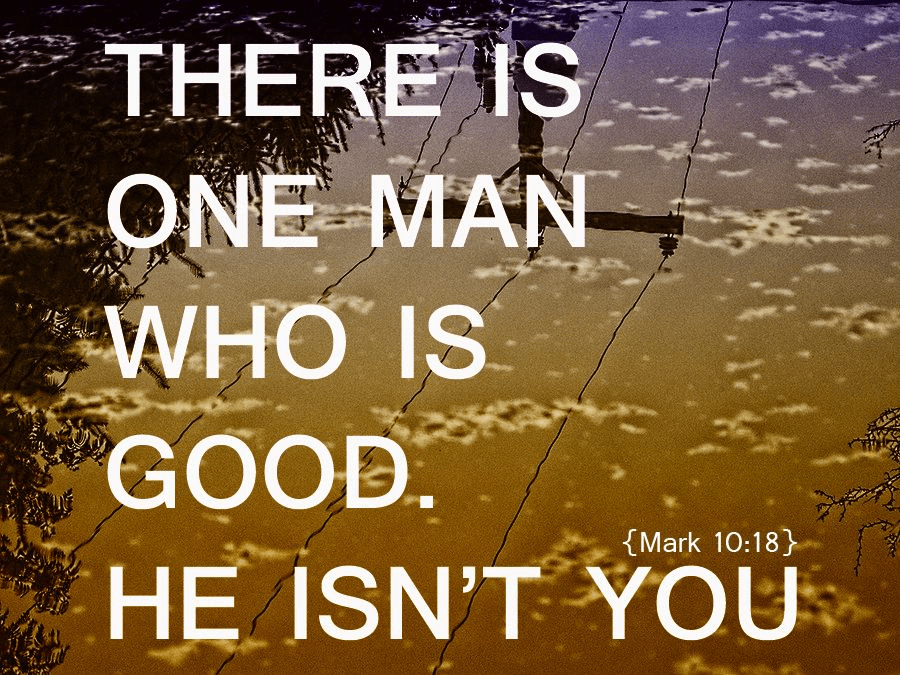
Mark 10:17–18 (ESV) says, “17 And as he was setting out on his journey, a man ran up and knelt before him and asked him, “Good Teacher, what must I do to inherit eternal life?” 18 And Jesus said to him, “Why do you call me good? No one is good except God alone.”
Luke 18:18–19 (ESV) – “18 And a ruler asked him, “Good Teacher, what must I do to inherit eternal life?” 19 And Jesus said to him, “Why do you call me good? No one is good except God alone.”
A rich, young man approached Jesus one day. He asked the Lord a question. It was “Teacher, what good deed must I do to have eternal life?” The rich, young man did not acknowledge Jesus as Lord and God. Rather, he addressed Him as a teacher, instructor or rabbi. He assumed that being a wise teacher, Jesus possessed eternal life and knew how others could get it.
The young individual was mistaken.. He thought eternal life was the result of him performing some good deed, favor, or moral act. In his mind, eternal life was the result of his own personal achievements.
“Steeped in the legalism of his day, the young man naturally thought in terms of some religious deed that would guarantee him eternal life. His lack of understanding about the true nature of salvation, however, does not mean he was insincere,” explains Dr. John MacArthur.
Jesus’ response to the young man directed him to a greater principle and purpose. And he said to him, “Why do you ask me about what is good? There is only one who is good. If you would enter life, keep the commandments.”
Good (ἀγαθός; agathos) refers to generosity and graciousness. Jesus asked the young man why he called Him good, or a good teacher. The Lord acknowledged the only one who was good, the source of generosity and grace, was God alone. He also stated that eternal life could be acquired by keeping God’s commandments. However, as noted in our previous devotional, fallen sinners are incapable of perfectly and completely keeping God’s commandments; nor do they desire to do so.
“Certainly what God demands in His law is good, for God himself is the Highest Good. Why ask Jesus about “that which is good” when God the Father has so clearly revealed it? If the enquirer thinks that he will be able to obtain everlasting life by doing good, let him then by all means keep the commandments,” observes Dr. William Hendriksen.
“Our Lord knows the man is looking for more, but He starts with the law of God, for the Law is where salvation begins. Jesus reminds the man that His Father defines goodness and that obeying Him is the way to eternal life (vv. 17–19),” explains Dr. R. C. Sproul.
“Jesus is not teaching that we are able to obey God perfectly and merit redemption. Only in trying to keep the Law will we see our failure and need of Christ, who flawlessly kept God’s law in our place (Rom. 5:20–21; 2 Cor. 5:21; Gal. 5:2–5).”
John Calvin writes that “the keeping of the law is righteousness, by which any man who kept the law perfectly — if there were such a man — would obtain life for himself. But as we are all destitute of the glory of God (Rom. 3:23), nothing but cursing will be found in the law; and nothing remains for us but to betake ourselves to the undeserved gift of righteousness.”
Soli deo Gloria!
 His Word Today