
31 When his fellow servants saw what had taken place, they were greatly distressed, and they went and reported to their master all that had taken place. 32 Then his master summoned him and said to him, ‘You wicked servant! I forgave you all that debt because you pleaded with me. 33 And should not you have had mercy on your fellow servant, as I had mercy on you?’ 34 And in anger his master delivered him to the jailers, until he should pay all his debt. 35 So also my heavenly Father will do to every one of you, if you do not forgive your brother from your heart.” (Matthew 18:31–35 (ESV)
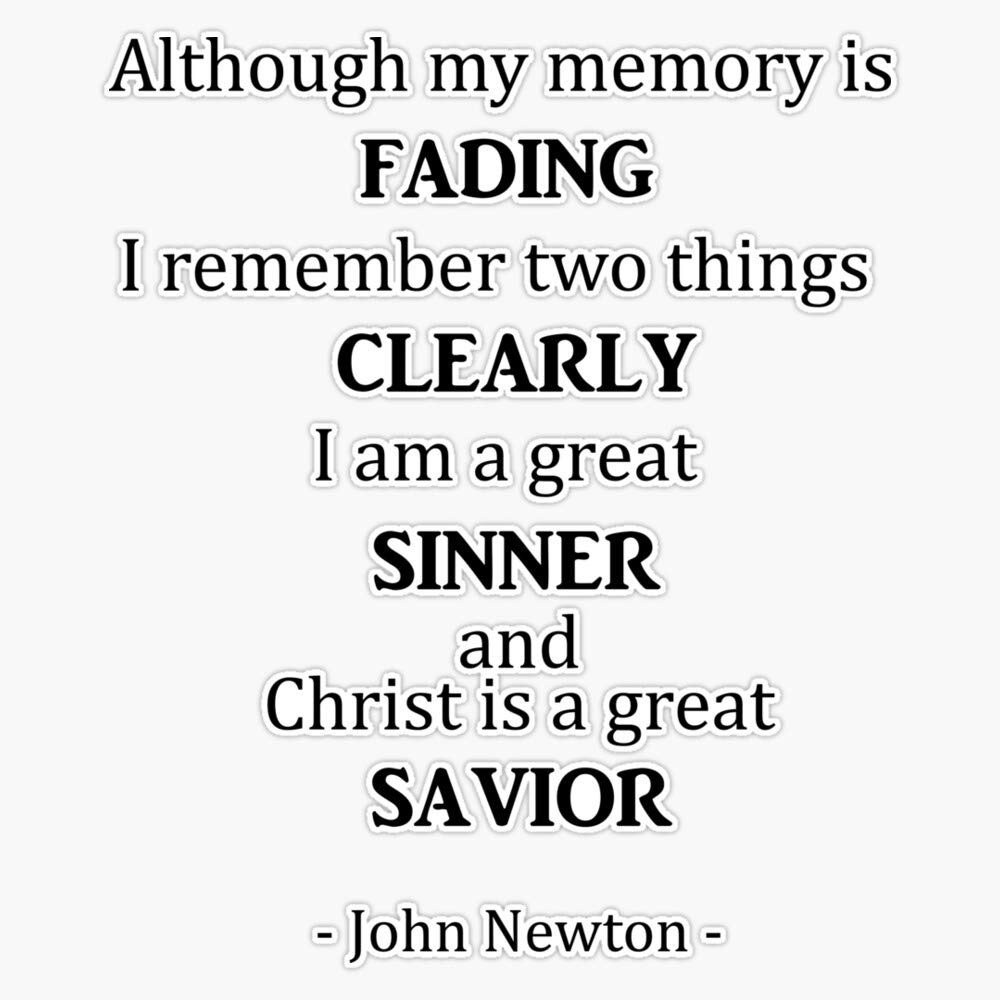
“Although my memory’s fading, I remember two things very clearly: I am a great sinner and Christ is a great Savior.” ― John Newton, Amazing Grace.
For the most part, believers in Christ acknowledge that Jesus Christ is a great Savior. Individuals have written songs and books, and preached great sermons testifying to the great love of God in sending His Son, Jesus Christ, as both Savior and Lord. The familiarity of John 3:16, even in a superficial understanding, underscores this biblical truth.
A disconnection arises when believers in Christ fail to acknowledge that prior to their conversion, and after God’s great salvation, they were/are great sinners. There is a tendency to minimize our own sin, while at the same time maximize the sins of others; especially when they sin against us. We must never forget the greatness of God’s salvation, as compared to the greatness of our sin. John Newton never did.
Unfortunately the first servant, in the context of Matthew 18:23-30, forgot God’s mercy and forgiveness for his unpayable debt. He displayed this callousness by his cruel treatment of a fellow servant, who owed the former a comparatively smaller, payable debt.
When other servants heard about this situation, they were greatly distressed or saddened. They reported what had happened to the master of them all; including the unforgiving servant.
What did the master say? 32 “Then his master summoned him and said to him, ‘You wicked servant! I forgave you all that debt because you pleaded with me. 33 And should not you have had mercy on your fellow servant, as I had mercy on you?’ Mercy received should result in mercy given. How soon we forget the greatness of our sin with respect to the greatness of God’s forgiveness. I’m ashamed to say that I often have.
What did the master do? 34 “And in anger his master delivered him to the jailers, until he should pay all his debt. 35 So also my heavenly Father will do to every one of you, if you do not forgive your brother from your heart.”
“The point of the parable is not that God’s forgiveness, once granted, will be revoked if a follower of Jesus refuses to forgive his brother or sister. Rather, refusal to forgive is symptomatic of a person who fails to grasp the impossible depth of his debt and the infinite magnitude of God’s mercy and therefore has no reason to presume that he has received God’s forgiveness in the first place,” explains Dr. R. C. Sproul.
Do you identify with John Newton’s sentiment? Do you acknowledge that you are a great sinner and that Jesus Christ is a great Savior? Ask God to forgive you of your unforgiving spirit. Ask God to constantly remind you that mercy received should result in mercy given.
Soli deo Gloria!
 His Word Today