
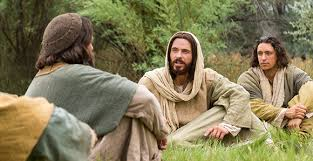
13 “Now when Jesus came into the district of Caesarea Philippi, he asked his disciples, “Who do people say that the Son of Man is?” 14 And they said, “Some say John the Baptist, others say Elijah, and others Jeremiah or one of the prophets.” 15 He said to them, “But who do you say that I am?” 16 Simon Peter replied, “You are the Christ, the Son of the living God.” 17 And Jesus answered him, “Blessed are you, Simon Bar-Jonah! For flesh and blood has not revealed this to you, but my Father who is in heaven.” (Matthew 16:13–17 (ESV)
The question Jesus posed to His disciples was a continuation of His teaching ministry to them. He previously taught them about meeting the needs of others (Matt. 15:21-39) and to be cautious of the teachings from the Pharisees and Sadducees (16:1-12). Peter’s confession of Jesus Christ’s deity is also found in Mark 8:27-30 and Luke 9:18-21.
The district of Caesarea Philippi was approximately twenty-five miles north of the Sea of Galilee, bordering the country of Syria. Situated near one of the sources of the Jordan River, with 9,232 feet high and snow-covered Mt. Hermon in the background, it was a beautiful and picturesque location of serenity, quietness and privacy. It was also the ideal place for an all important question.
It is obvious from the grammar of the text that Jesus began to continuously ask His disciples “Who do people say that the Son of Man is?” The phrase Son of Man is not a reference to Jesus’ humanity but rather His deity. In other words, Jesus asked His disciples what people were saying about Him. Who did they think He was?
The disciples responded that ““Some say John the Baptist, others say Elijah, and others Jeremiah or one of the prophets.” Some had also called Jesus an ally of Satan (Matt. 10:25; 12:24-26), but the disciples only reported the complementary opinions. The people apparently believed that Jesus was not the Messiah but rather a resurrected Old Testament prophet.
“Jesus asked the disciples, “Who do people say that I am?” In so doing, He set up a contrast between what His closest friends thought about His person and work and what those outside of the group, those who did not know Him, thought about Him. Their responses are instructive—first-century Jews, by and large, placed Jesus in the same class as the greatest prophets, a class including John the Baptist and Elijah (v. 28). As one commentator notes, the people saw our Lord not just as a prophet but as one of the prophets, those whose influence set them apart from everyone else who exercised a prophetic ministry,” states Dr. R. C. Sproul.
Jesus then asked, ““But who do you say that I am?” This was a far more important question. It was then that Simon Peter replied, ““You are the Christ, the Son of the living God.”
The disciples previously had exclaimed that Jesus was God’s Son (Matt. 14:33). This would in effect mean that Jesus was God (John 5:18). Perhaps it was at this point that the disciples’ conviction as to Jesus’ identity had taken hold in their minds, emotions and will.
“When Peter declared Jesus to the “the Christ” he means the long awaited Anointed One, the One who as Mediator was set apart or ordained by the Father and anointed with the Holy Spirit, to be His people’s Prophet (Deut. 18:15-18; Isaiah 55:5; Luke 24:19; Acts 3:22; 7:37); Highpriest (Psalm 110:4; Rom. 8:34; Heb. 6:20; 7:24; 9:24) and eternal King (Psalm 2:1-6; 11:15; 12:10-11; 17:14; 19:6),” explains Dr. William Hendriksen.
Jesus’ response to Simon was commendable. He said, ““Blessed are you, Simon Bar-Jonah! For flesh and blood has not revealed this to you, but my Father who is in heaven.” Simon did not understand this truth because of his own mental ability. Rather, God the Father providentially illuminated Simon and gave him insight and understanding as to Jesus’ true identity.
“The confession of Jesus as Christ, as Messiah, as the “Anointed One,” is the fundamental Christian confession. Prophets, priests, and kings were anointed under the old covenant (Ex. 40:12–15; 1 Sam. 16; 1 Kings 19:16). So, the confession of Jesus as Messiah recognizes that Jesus is the Prophet who reveals to us God’s will, the Priest who sacrifices Himself to atone for our sin, and the King who is Lord over creation,” explains one commentator.
“The church stands strong and unconquerable as long as it remains committed to its confession that Jesus is the Christ. . . . A loss of confidence as to the identity of Jesus does not disrupt merely the external trappings of the church; it disrupts the church’s foundation. We who confess the name of Christ must remain firm in our conviction that He is God in the flesh,” concludes Dr. Sproul.
Soli deo Gloria!
 His Word Today