
5 “When the disciples reached the other side, they had forgotten to bring any bread. 6 Jesus said to them, “Watch and beware of the leaven of the Pharisees and Sadducees.” 7 And they began discussing it among themselves, saying, “We brought no bread.” 8 But Jesus, aware of this, said, “O you of little faith, why are you discussing among yourselves the fact that you have no bread? 9 Do you not yet perceive? Do you not remember the five loaves for the five thousand, and how many baskets you gathered? 10 Or the seven loaves for the four thousand, and how many baskets you gathered? 11 How is it that you fail to understand that I did not speak about bread? Beware of the leaven of the Pharisees and Sadducees.” 12 Then they understood that he did not tell them to beware of the leaven of bread, but of the teaching of the Pharisees and Sadducees.” (Matthew 16:5–12 (ESV)
In light of Jesus’ use of leaven as a spiritual and theological metaphor for ungodliness and hypocrisy, today’s installment concerns the biblical use of the word leaven. The following information is taken from the Tyndale Bible Dictionary.
“Leaven is any substance that produces fermentation when added to dough. Leaven may signify the dough already infected by leaven, which was put into the flour so that the leaven could pass through the entire mass before baking, or it may refer to dough that had risen through the influence of the leaven. The early Hebrews apparently depended on a piece of leavened dough for transmission of the leaven; not until much later were the lees of wine used as yeast.”
“The ancient Israelites regularly ate leavened bread (Hos 7:4), but in the commemoration of the Passover they were forbidden to eat leavened bread or even to have it in their homes during the Passover season (Ex 13:7). This annual observance ensured that the people would not forget their hasty exodus from Egypt, when God’s command gave no time for the preparation of leavened bread. The people were forced to carry with them their kneading troughs and the dough from which they baked unleavened cakes to sustain them as they journeyed (Ex 12:34–39; Deut 16:3).”
Possibly because fermentation implied disintegration and corruption, leaven was excluded from all offerings placed on the altar to be sacrificed to God (Ex 23:18; 34:25). It was also not permitted in grain offerings (Lev. 2:11; 6:17). Scripture does not tell us whether or not the showbread (or bread of the Presence) was unleavened, but the historian Josephus states that it was unleavened (Antiquities 3.6.6).
“Two exceptions to this rule should be noted. Leaven could be used in offerings that were to be eaten by the priests or others. Leavened bread could accompany the peace offering (Lev. 7:13), and it was sacrificed at the Feast of Weeks (Pentecost) because it represented the ordinary daily food that God provided for his people (23:17).”
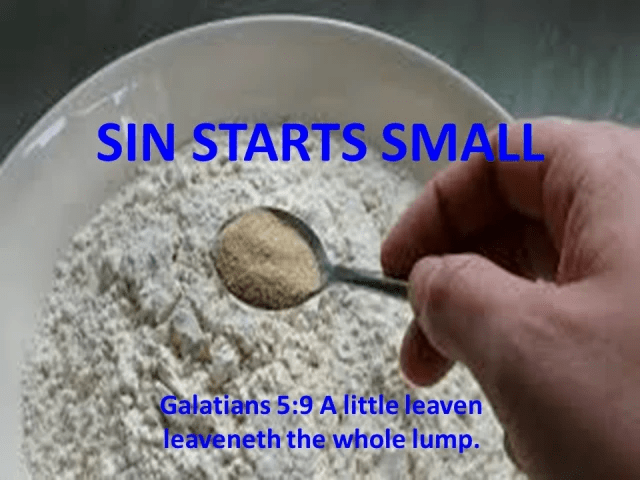
“The slow working of the leaven proved to be a problem during the agricultural stage of Hebrew development, especially during the first busy days of harvest. Unleavened dough, therefore, became increasingly common for ordinary baking. This practice was encouraged by the growth of the idea that leaven represented decay and corruption, as did other fermented things. This view excluded leaven as inconsistent with the concept of the perfect holiness of God. Plutarch was expressing a long- held belief current also among other people when he wrote, “Now leaven is itself the offspring of corruption and corrupts the mass of dough with which it has been mixed.” The apostle Paul quotes a similar proverb in 1 Corinthians 5:6 and Galatians 5:9.”
“The significant thing about leaven is its power, which may symbolize either good or evil. Usually, though not always, leaven was a symbol of evil in rabbinic thought. Jesus referred to leaven in the adverse sense when he used the word to describe the corrupt doctrine of Pharisees and Sadducees (Mt 16:6, 11–12) and of Herod (Mk. 8:15). The leaven of the Pharisees is elsewhere identified as hypocrisy (Lk. 12:1; cf. Matt. 23:28).”
“Paul applies the same concept to moral corruption, warning that “a little leaven leavens the whole lump” and admonishing his readers to clean out the old leaven, that is, the vestiges of their unregenerate lives, and to live the Christian life with the “unleavened bread of sincerity and truth” (1 Cor. 5:6–8).”
“On the other hand, Christ uses the concept of leaven’s effect upon dough in its good sense to provide his disciples with a brief but memorable parable (Mt 13:33; Lk 13:20–21), wherein leaven illustrates the cumulative, pervasive influence of the kingdom of God on the world.”[1]
More to come. Have a blessed day in the Lord.
Soli deo Gloria!
[1] Walter A. Elwell and Philip Wesley Comfort, Tyndale Bible Dictionary, Tyndale Reference Library (Wheaton, IL: Tyndale House Publishers, 2001), 807–808.
 His Word Today